
Rethinking AppSec UX:
Endor Labs Agentic Chat
Transforming Endor Labs’ user experience from dashboards and filters to intelligent, conversational workflows
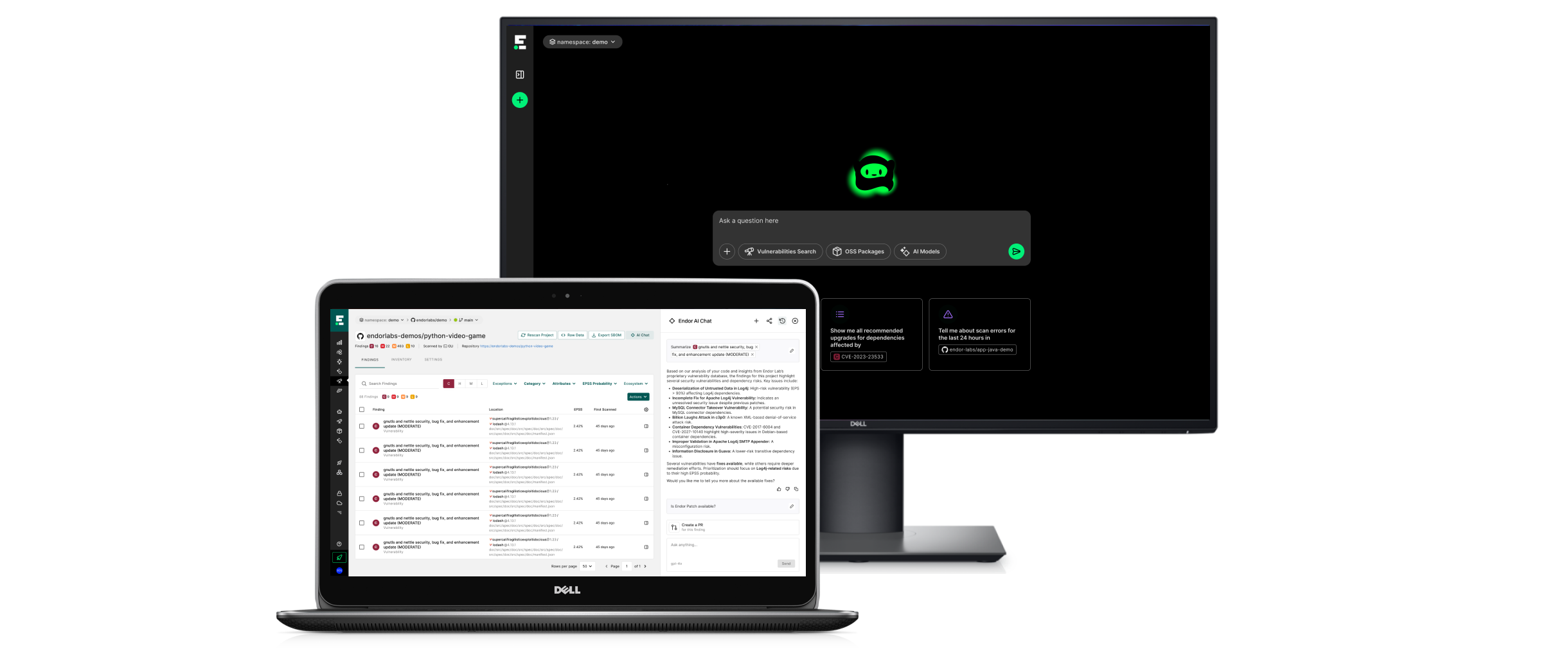
TLDR
In 2025, I led the design transformation of Endor Labs’ security workflow from dashboard-driven navigation to an agentic, action-oriented conversational system.
Rather than layering chat on top of existing UI, we re-architected how AppSec engineers discover, triage, and remediate vulnerabilities: shifting from manual filtering to AI-driven execution.
My Role
As the Principal Product Designer for this initiative, my contributions included:
Defined the Agentic UX interaction model
Partnered with CTO and AI engineering to design action orchestration flows
Led qualitative research with enterprise AppSec teams
Designed trust calibration and confirmation patterns for AI execution
Shaped 0→1 product direction for conversational security workflows
The Problem: Triage is Navigation-Heavy
Enterprise security platforms are powerful but complex. AppSec engineers often spend valuable time navigating dashboards, configuring filters, and translating vulnerability data into actions. Traditional triage flow looked like this:

Through research, we identified a fundamental friction:
High cognitive load
Frequent context switching
Manual repetition
The Research: Understanding How Users Triage
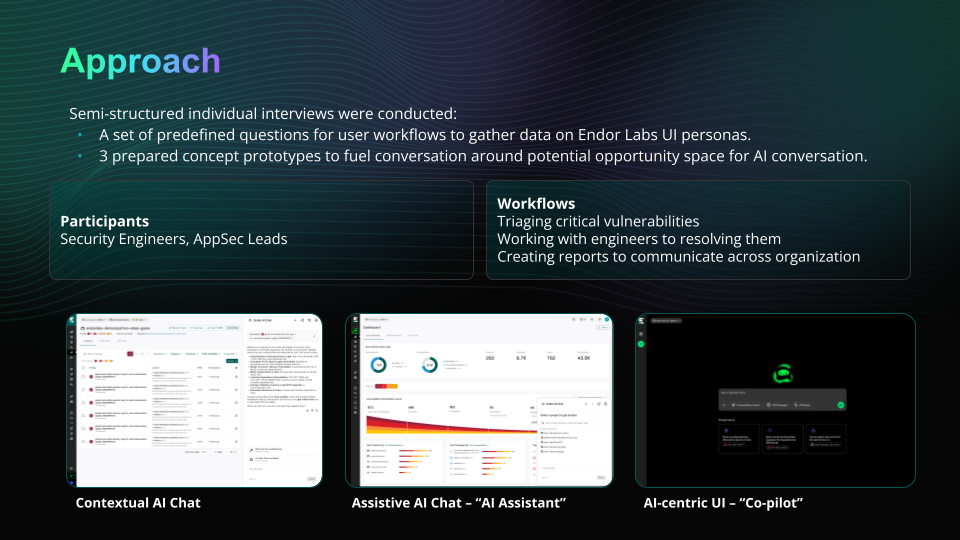
We conducted qualitative studies with AppSec engineers and security leaders to understand:
How they prioritize findings
When they trust automation
What slows them down during triage
What actions they repeat frequently
Conversational interfaces vs. traditional UI navigation
Key Insights
-
Delegation Threshold
Users were willing to delegate repeatable actions (dismissals, policy enforcement), but required contextual transparency before execution.
→ Design implication: AI must show reasoning before acting.
-
Not Just Summary
Users rejected summary-only AI. Without switching contexts, they wanted to:
• Create PRs
• Generate Jira tickets
• Apply patches
• Compare scans→ Design implication: Chat becomes an execution surface.
-
Adaptive Memory Builds Trust
Users expected the system to learn:
• Risk tolerance
• Policy preferences
• Past decisions→ Design implication: Persistent contextual memory.
The Solution:
Simplified Triage Workflow
Agentic Chat supports triage through reduced steps:

Traditional Triage needs 8-10 navigational steps.
Agentic Triage reduced to 3-6 contextual steps
~40% reduction in triage time
-
Surface What Matters
Users begin triage by understanding scope and change. Instead of configuring filters manually, the chat:
• Retrieves relevant scan context
• Highlights deltas
• Surfaces severity and dependency depth -
Assess Risk & Impact
After identifying findings, the chat supports decision-making by:
• Explaining impact inline
• Surfacing related vulnerabilities
• Showing policy conflicts
• Providing reasoning for recommendations -
Take Action Without Leaving Context
Triage completes with action all directly from the conversation. Agentic Chat enables:
• Creating Jira tickets
• Opening pull requests
• Applying patches
• Dismissing findings with justification
Design Decisions
-
Context-Aware Conversation
Chat dynamically adapts based on where the user is: Projects, Findings, or Scan History, and offers tailored prompts and responses.
-
Endor Vulnerability Database Integration
Users can instantly access deep context on vulnerabilities: impacts, related issues, and recommended fixes, without leaving the chat.
-
Compare Scans Instantly
Chat highlights differences between scans, helping teams track remediation progress and identify new risks faster.
Design Trade Offs
-
Sidebar vs. Full-Screen Takeover
We chose a contextual sidebar instead of replacing the primary interface in order to:
• Preserved existing workflows for cautious users
• Enabled gradual adoption
• Reduced disruption in enterprise environments -
Context-Aware Prompts vs. Global Assistant
Rather than a generic assistant, prompts adapt to project, finding, or scan context. This reduced ambiguity and improved relevance.
Impact
Agentic Chat transformed triage from navigation-heavy analysis to action-oriented execution. Early impact included:
↓ ~40% reduction in average triage time
↓ 30–50% fewer navigation steps per session
65%+ pilot adoption with repeat triage usage
50%+ increase in direct remediation actions from chat
Long-Term Vision
Agentic Chat established the foundation for:
Multi-agent remediation workflows
Cross-repo vulnerability campaigns
Adaptive learning based on user patterns
This initiative moved Endor Labs toward an action-oriented security platform.
Reflection
Three lessons shaped the direction of this work:
Automation is accepted when reasoning is visible.
Engineers value control over speed in high-impact workflows.
Reducing navigation can matter more than increasing features.
Over time, the goal became less about conversational UI and more about decision support. This project laid the foundation for a more execution-oriented security platform.